About identification management
Effective identification management helps organisations to reduce or prevent fraud, loss of privacy and identity theft by applying good practice processes.
The identification management concept
Identification management is the term used today for a concept that has been around since Entities became aware – Entities meaning ‘something that has real or distinct existence from other things’.
While it started as a set of natural processes that were just part of day-to-day interactions, it’s now a formal practice that reflects the processes of:
- verifying information
- connecting it to Entities, including people
- connecting these to reusable Authenticators.
It applies from the first engagement with (or enrolment of) an Entity and throughout the lifetime of the relationship, whether online, in person or over the phone.
The identification management approach acknowledges the difference between the Entity in the real world, person or non-person, and the representation of them in a system or context.
Find definitions of key terms used in identification management — Identification terminology.
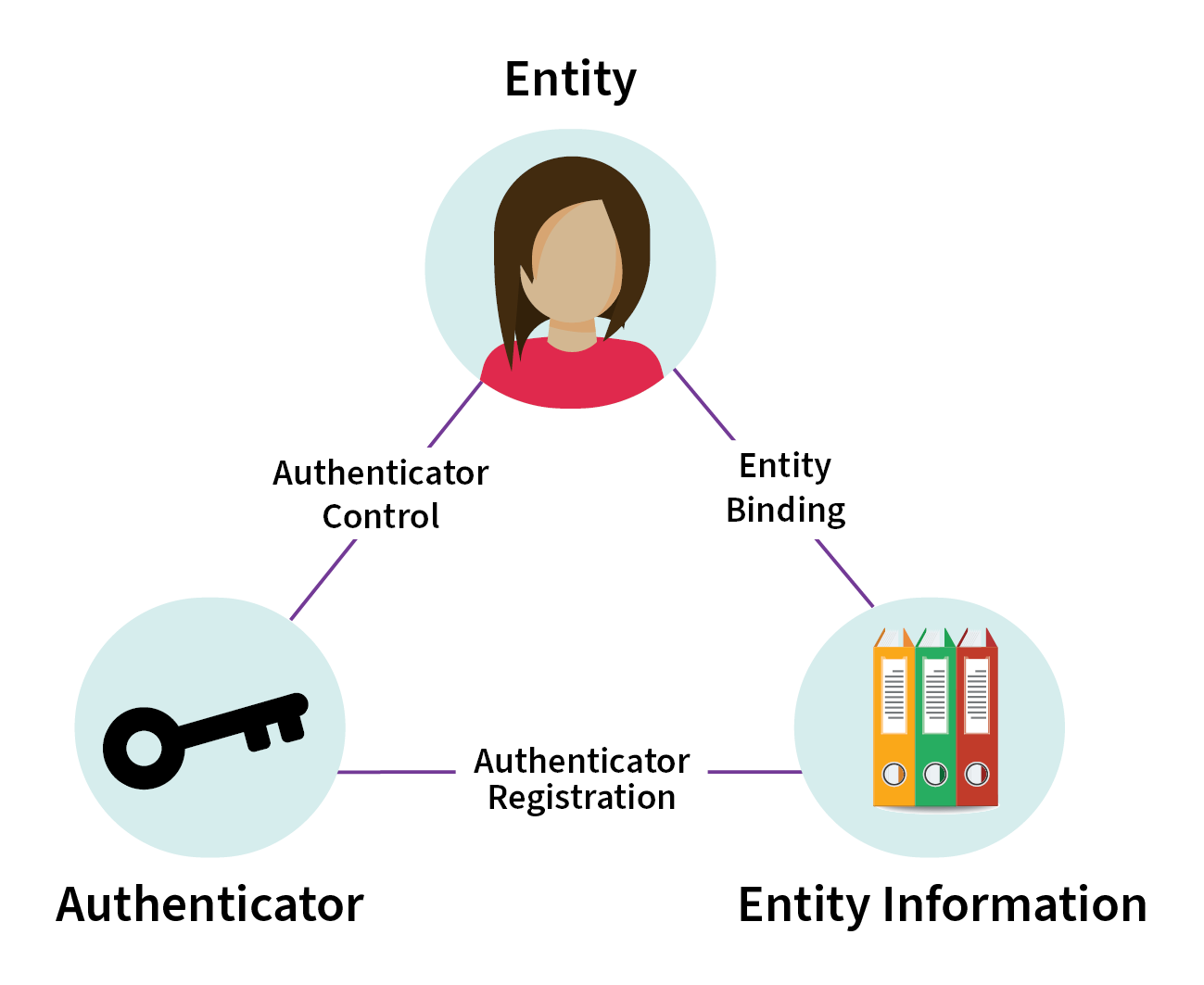
Detailed description of diagram
The diagram shows a triangle representing the connection between Entity (in this example, represented by a person) at the top of the triangle, Authenticator (represented by a key) at the bottom left, and Entity Information (represented by files of information) at the bottom right.
The connection between Entity and Entity Information is labelled Entity Binding, the connection between Entity Information and Authenticator is labelled Authenticator Registration and connection between Authenticator and Entity is Authenticator Control.
Why identification management is important
Effective identification management helps to reduce the impacts of identity theft. Identity theft can result in fraud, loss of privacy and security, and have a detrimental effect on both an organisation and its customers.
Good identification management practices contribute to effective decision-making and mitigation of risks. Identification works with privacy and security to protect information assets.
The identification management elements
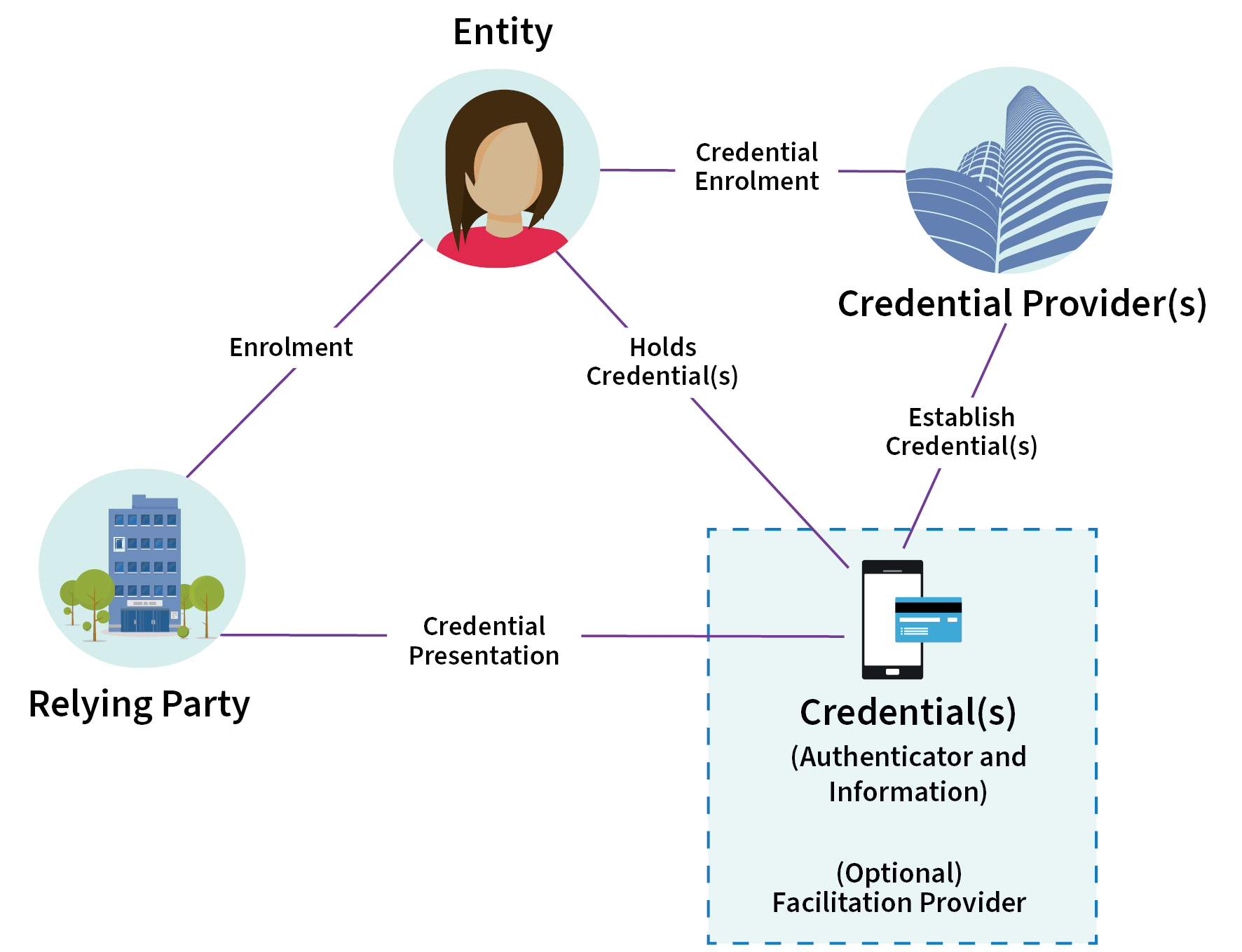
Multiple elements are needed in identification management to achieve the desired outcomes for Entities, such as people, when they interact with many Relying Parties, systems and contexts.
The diagram below shows how these elements work together.
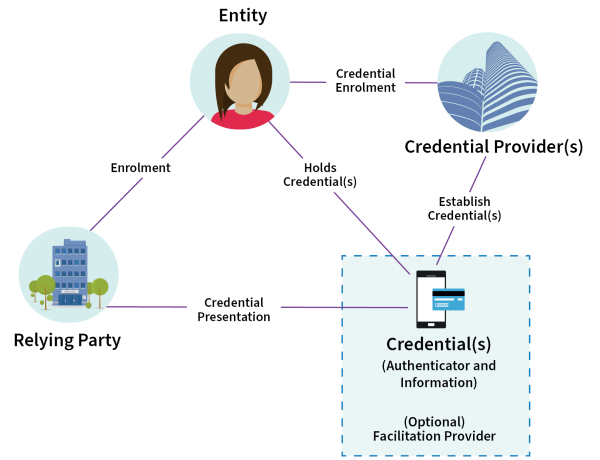
Detailed description of diagram
The diagram shows an Entity (for example, a person) who wants to get a Credential that they can use to get a service from a Relying Party (for example, an organisation). The Entity goes to a Credential Provider to get an applicable Credential and then either presents their Credential directly to the Relying Party or the Credential Provider presents it to the Relying Party for them, sometimes via a third-party.
Descriptions of the elements and their relationships
These elements and the wider language around them make understanding the field of identification management complex. To help simplify things a list of identification terminology and how it is used has been developed.
Support for identification management
To support the field of identification management 5 technical standards have been published along with a range of guidance.
Training courses and drop-in clinics are available to aid in the development of capability in this field.
The Identification Management Team at the Government Digital Delivery Agency provide independent advice and guidance.
Contact the Identification Management Team
Identification management and other practices
Identity management
Identity and identity management tend to focus on minimal attributes and their management.
This field has been established in the information security space over the last 40 years, though the language is being adopted more widely.
The identity management approach delivers information system functionality rather than addressing wider business and user needs. It also misses many of and the processes and human behaviours needed to prevent identity theft and the impacts of this.
The material on this site takes a different and broader approach to guide best practice and the effective development of solutions.
Digital identity
Digital identity is a term used for several concepts including electronic credentials, digital enrolment and social footprint.
It can also mean the application of identity management or identification management in the digital channel, digital identification. In New Zealand, the Digital Identity Services Trust Framework is developing a system of accredited digital providers.
Trust framework for digital identity
Privacy and security
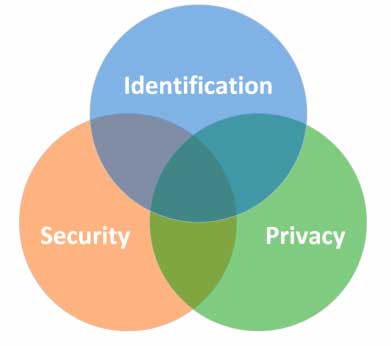
Identification management is a practice that is separate from but closely related to Privacy and Security. While several requirements within the Identification Standards contribute to information privacy and security, they do not replace the need to apply relevant standards within these separate practices.
Detailed description of diagram
The diagram shows 3 overlapping circles. The circles represent different fields of practice and are labelled Identification, Privacy and Security. The overlapping of the circles indicates that the practices are not totally independent of each other but have some things in common. Some of the commonality is between any 2 of the practices, and in some cases between all 3.
Utility links and page information
Last updated